
Towing service in Lapland | find the nearest tow truck
When your car breaks down in Rovaniemi, Kemi, Sodankylä, Inari or elsewhere in Lapland, the nearest help is found most accurately based on your location. The map brings towing and roadside assistance companies in the area into one view, allowing you to review options, confirm availability and arrange assistance directly with your chosen company. HinausSuomi.fi is free to use and requires no registration.
Towing and roadside assistance for common situations
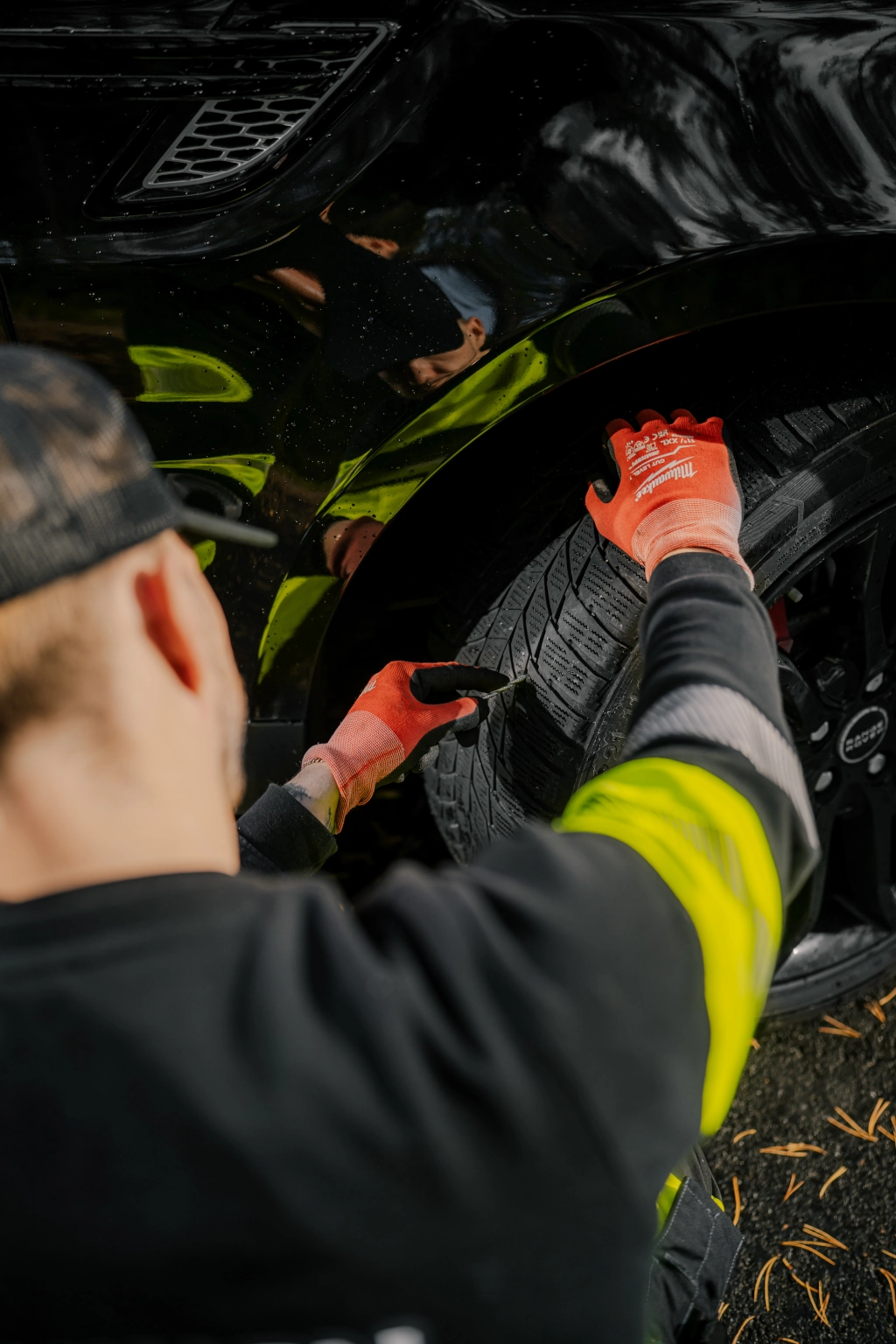
Flat tyre
Fast help for a flat tyre anywhere in Finland.

Technical fault
Has your journey been interrupted?
Find the nearest help on the HinausSuomi map.

Collision
A nationwide network can recover your vehicle from the scene of a collision.
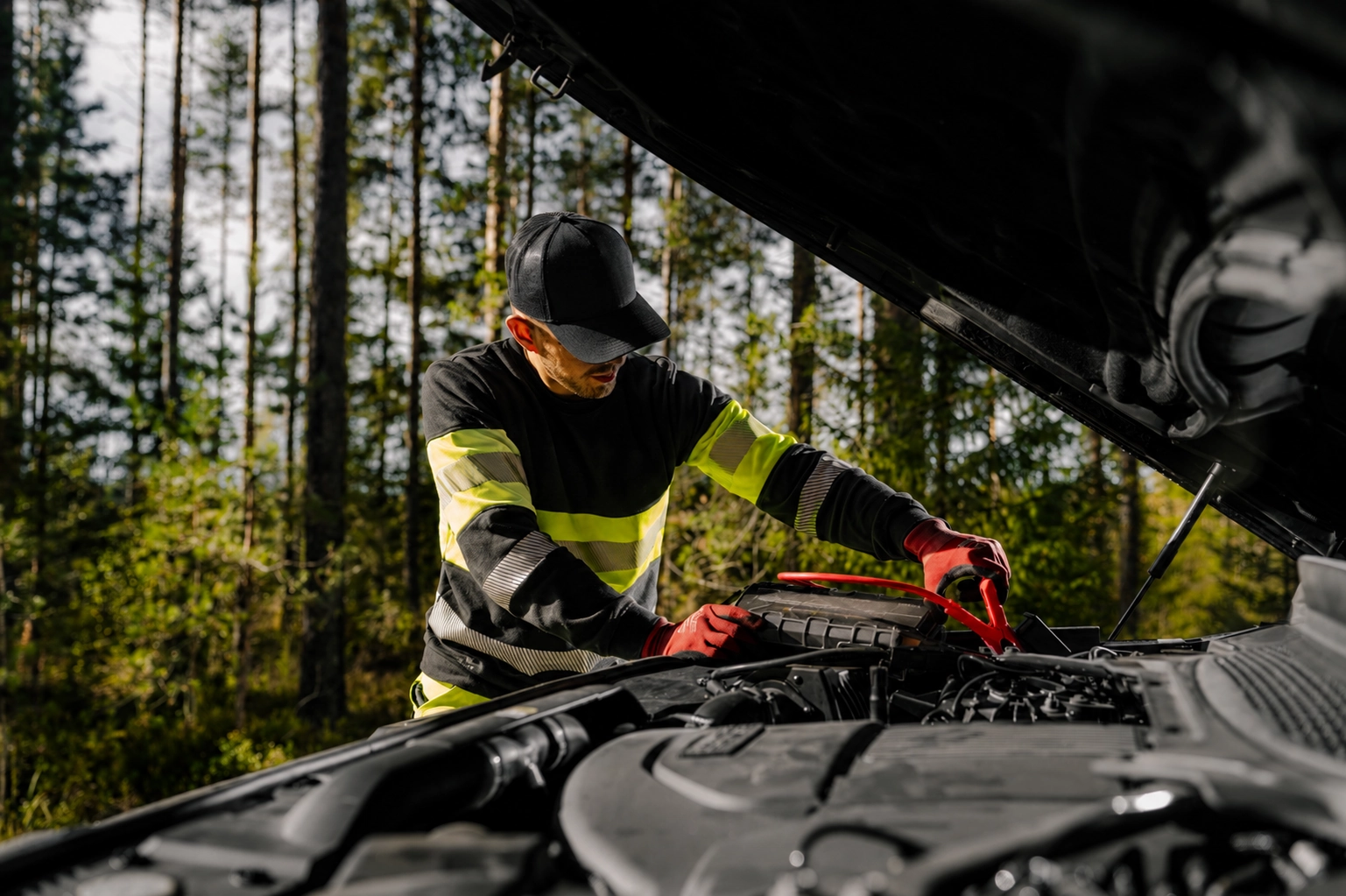
Jump-start
Flat battery?
Request a jump-start from the nearest towing company.
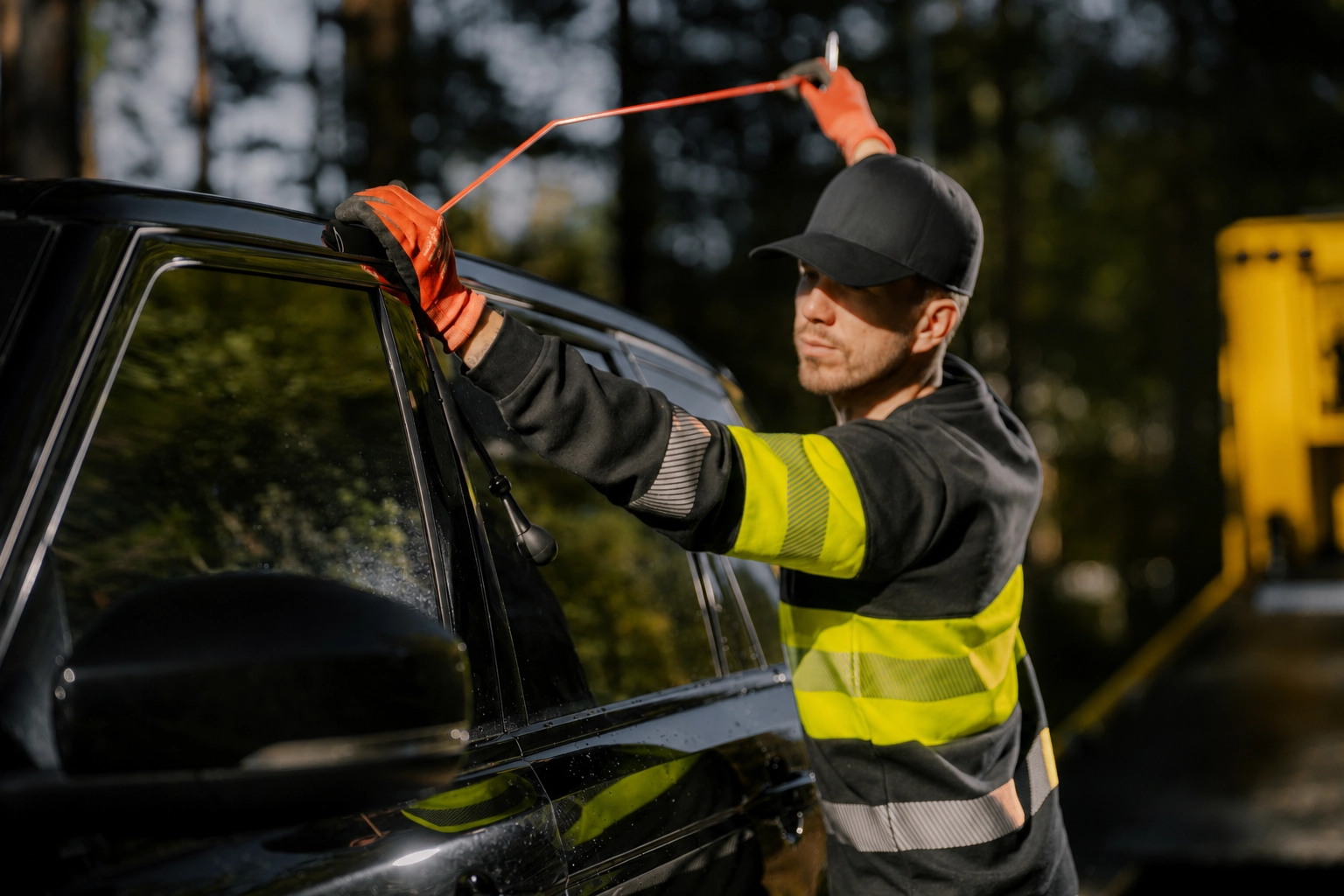
Vehicle lockout
Locked your keys inside the car?
Fast help across Finland.
Fuel delivery
Run out of fuel?
Our network can deliver fuel to your location.
How to find the nearest towing service
1
Select the nearest towing company.
2
Call the company directly.
3
Share your location.
4
Describe the vehicle and the problem.
5
The tow truck sets off.
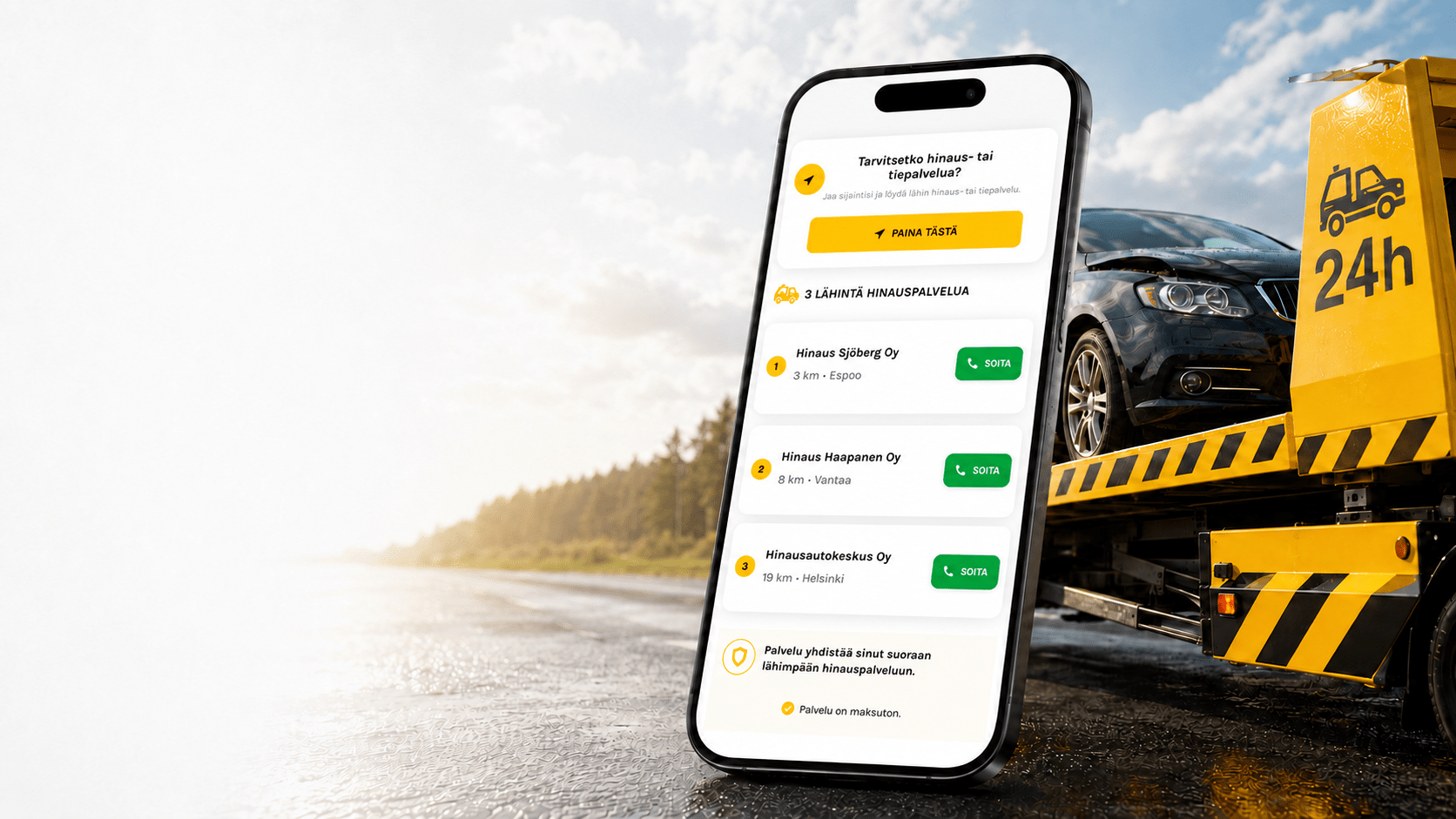
Lapland
towing companies near you
on one map
The cost of towing in Lapland is based on the vehicle, location, complexity of the job and transport distance. Moving a passenger car within Rovaniemi is generally a simpler task than collecting a vehicle hundreds of kilometres away on the Utsjoki fell plateau or recovering one from a snowy wilderness road. The time of day, weather, traffic, required equipment, recovery work and accessibility of the location also affect the price.
Roadside assistance or towing cover included in comprehensive motor insurance may reimburse all or part of the transport. The policy terms determine whether the fault is covered, where the vehicle may be transported, whether an excess applies and how much of the transport distance is reimbursed.
Many towing companies can invoice the insurance company directly. Before requesting assistance, confirm whether direct billing is available, what information the company needs and whether you will need to pay any part of the cost.
If insurance does not cover the job, request a price estimate by phone. Provide the exact location, vehicle make and model, the nature of the fault or damage, any trailer, road conditions and the preferred destination. HinausSuomi.fi is free to use. The price, payment methods and terms of the work are determined by your chosen company.
Highway 4 is Lapland’s main north–south route, running from Keminmaa through Rovaniemi and Sodankylä towards Inari and Utsjoki. Highway 21 follows the Tornio and Muonio river valleys towards Kilpisjärvi, Highway 29 connects Keminmaa and Tornio, and Highway 5 serves connections between Posio, Kemijärvi and Sodankylä. Main Roads 79 and 82 lead to destinations in the fells and eastern Lapland.
When a vehicle stops on a main road, provide the road number, direction of travel, the carriageway you are on, the nearest interchange and any kilometre marker. On a side road, provide the road name, junction, barriers, bridges and the last firm turning area.
Prioritise safety. Switch on the hazard warning lights, move the vehicle off the traffic lane if possible and move yourself and your passengers to a place protected from traffic. Call 112 in the event of injury, fire or an immediate collision risk.
The location shown as nearest on the map does not always have the nearest available tow truck. Confirm the arrival time, on-call service area and suitability of the equipment, especially when the location has heavy traffic, a steep ditch, a narrow bridge or a soft private road.
HinausSuomi.fi map ordering is based on companies’ business-location and location data, not paid visibility. You can review nearby options and contact your chosen service provider directly.
The distance to a business location does not indicate the tow truck’s current position or when it will become available. In Lapland, exceptionally long distances, reindeer, rapidly changing weather in the fells, severe frost and limited alternative routes can make a journey that looks short on the map take a long time. Always confirm availability and the estimated arrival time by phone.
FAQ
No. You can locate the vehicle, view towing companies in Lapland, open their contact details and call a company without signing in, becoming a member or installing a separate app.
It may, if the vehicle assistance, roadside assistance or towing cover included in your insurance covers the situation. Reimbursement is affected by the cause of the fault, the transport destination, the distance and any excess. In Lapland, it is advisable to check separately the terms concerning recovery from a wilderness road, an exceptionally long transport journey and specialist equipment for a motorhome.
Call your chosen company and provide the exact map location, vehicle size, fault, time and preferred transport destination. Mention specifically if the vehicle is on Highway 4, a fell road, near a reindeer separation site, in a snowbank or hundreds of kilometres from a repair shop, as these details affect the equipment required and the price estimate provided in Lapland.
The arrival time depends on the available vehicle’s departure location, road conditions, weather, traffic and the complexity of the job. In Lapland, the distance from the departure location, reindeer, blowing snow, severe frost, closures of fell roads and traffic during tourist seasons may increase the waiting time.
Towing companies providing round-the-clock on-call service operate in Lapland, but the availability of vehicles and companies’ on-call service areas vary. For night-time and weekend jobs, or assistance during severe frost or a fell storm, on a wilderness road or for a long collection from a border area, confirm availability, the estimated arrival time and any on-call surcharge directly with the service provider.
More information
A journey may be interrupted on Highway 4 north of Sodankylä, on Highway 21 in Muonio, on a road serving a Kittilä tourist resort or on a forest section between Kemijärvi and Salla. Towing conditions in Lapland range from the urban areas of Sea Lapland to fell resorts, main roads in the reindeer husbandry area, sparsely populated wilderness and northern border connections.
HinausSuomi.fi lists service providers on the map in locations including Rovaniemi, Kemi, Sodankylä, Inari, Kittilä and Tornio and elsewhere in the region. Assistance may be needed because of a starting fault, flat tyre, run-off-road incident, collision, vehicle lockout, mechanical fault or running out of fuel.
If the problem can be resolved safely at the scene, roadside assistance may avoid the need for towing. Otherwise, the vehicle is transported to a repair shop, storage facility or another agreed destination. HinausSuomi.fi is a contact-information search service and does not dispatch its own vehicles. The customer chooses a company and agrees with it on arrival, price, transport, payment and insurance billing.
Always provide the road number, direction of travel, kilometre marker or map coordinates. Also state whether the phone connection works, the snow conditions, whether reindeer are present and the nearest warm shelter.
The map can be used to find towing and roadside assistance throughout Lapland. The region’s 21 municipalities are Enontekiö, Inari, Kemi, Kemijärvi, Keminmaa, Kittilä, Kolari, Muonio, Pello, Pelkosenniemi, Posio, Ranua, Rovaniemi, Salla, Savukoski, Simo, Sodankylä, Tervola, Tornio, Utsjoki and Ylitornio.
Assistance can be requested in an urban area, on Highway 4, at a fell resort, on a border-area road, in the reindeer husbandry area or on a long forest road. Share the exact location and mention in advance any barrier, weight-restricted bridge, slippery conditions, soft road, confined yard or low-clearance building.
A company’s appearance on the map does not guarantee immediate availability in every municipality. The service provider confirms its operating area, departure time and the suitability of its equipment.
The nearest business location is a useful starting point, but successful towing in Lapland also depends on available equipment, the vehicle type and accessibility of the location. A car park in Rovaniemi, a motorway in Kemi, a tourist resort in Kittilä and a fell road in Utsjoki require very different travel distances and equipment.
Locate the vehicle on the map, call a suitable company and describe the situation precisely. Confirm the arrival time, transport destination, suitability of the equipment and the price or insurance billing before accepting the job. HinausSuomi.fi is free to use; the customer’s payment is based on the agreement between the customer and the chosen company.
Not every fault requires the vehicle to be transported. A flat battery can often be jump-started, a locked door opened and a damaged tyre changed or repaired at the scene. Work can only be carried out in a safe environment; a narrow verge on Highway 4, visibility disappearing in a snowstorm, a herd of reindeer or an unploughed fell road may prevent work at the scene.
Towing is the safer solution if the vehicle’s roadworthiness cannot be confirmed, it is leaking fluid, the steering or drivetrain is damaged, the wheels are locked, the vehicle is in a ditch or incorrect fuel has entered the system. Describe the symptoms and location accurately so that the Lapland service provider can select a roadside assistance vehicle, flatbed tow truck or heavier recovery equipment.
The transport method is selected according to the vehicle’s construction, weight, drivetrain, damage and location. Passenger cars, electric vehicles, four-wheel-drive vehicles, long vans, motorhomes, motorcycles and heavy commercial vehicles require different lifting and securing solutions.
Provide the make, model, registration number, estimated weight, drivetrain and details of any trailer. In Lapland, the selection of equipment is also affected by deep snow, severe frost, long collection distances, the size of a motorhome and turning areas on wilderness roads.
When the company receives this information while the job is being arranged, it can select a tow truck suited to the vehicle and route, account for weight and load-bearing restrictions and provide a more realistic estimate of the duration of the work.
Passenger cars are the vehicles most commonly towed. Towing may be required because of a mechanical fault, traffic accident, flat tyre, electrical fault or starting problem. When necessary, the vehicle is transported safely to a repair shop, home or another destination chosen by the customer in accordance with the manufacturer’s instructions.
Towing a van often requires heavier equipment than transporting a standard passenger car. Whether it is a work vehicle, delivery van or privately used van, towing can be arranged after a breakdown or accident. When necessary, the vehicle can be taken directly to a repair shop or the company’s own premises.
Towing electric vehicles requires specialist knowledge because their drivetrains and high-voltage systems differ from those of conventional combustion-engine vehicles. Many electric vehicles must not be towed long distances with their wheels on the ground and are instead transported on a flatbed tow truck in accordance with the manufacturer’s instructions. This helps prevent possible damage to the electric motor, battery and drivetrain. If your electric vehicle’s battery is depleted or the vehicle develops a mechanical fault, a towing company with the correct equipment will transport it safely.
Transporting a motorcycle requires the correct securing equipment and careful handling. The motorcycle is secured firmly during transport so that it remains stable and is not damaged on the journey. Towing assistance may be needed after a mechanical fault, flat tyre or accident.
Motorhomes are larger and heavier than standard passenger cars, so towing them requires suitable equipment. A professional towing company will assess the vehicle’s size and weight and select the safest transport method. A motorhome can be taken to a repair shop, storage location or another destination requested by the customer.
Recovering trucks requires towing equipment suitable for heavy vehicles and specialist expertise. A professional towing company will assess the vehicle’s size, weight and extent of damage and select the safest towing or transport method. A truck can be taken to a repair shop, depot or another destination requested by the customer.
Not sure whether your vehicle can be towed? Contact the nearest towing company directly through the HinausSuomi.fi service. A professional will assess the situation and explain what equipment is suitable for your vehicle.
Roadside assistance aims to resolve the problem where the vehicle has stopped. Common jobs in Lapland include jump-starting a battery depleted by frost, dealing with a flat tyre, opening a locked door, delivering fuel and resolving minor starting or electrical faults.
Before setting off, the service provider assesses whether the work can be carried out safely at the location. A narrow verge on Highway 4, visibility disappearing in a snowstorm, a herd of reindeer or an unploughed fell road may restrict work at the scene.
If the fault cannot be repaired reliably or there is any uncertainty about the vehicle’s roadworthiness, the vehicle is transported with suitable equipment to a destination agreed in advance.
HinausSuomi.fi is a map-based search service where you can find contact details for towing and roadside assistance companies in Lapland. The map can be used to find a jump-start, tyre assistance or a tow truck, for example in Rovaniemi, Kemi and Sodankylä and elsewhere in the region.
The service does not set the price, choose a company for you or automatically forward a request. You contact the service provider yourself and agree on availability, transport destination, payment method and insurance matters.
In Lapland, it is essential to provide the road number, direction of travel, distance from the nearest urban area, weather, snow conditions and whether the phone connection works at the location.
Lapland’s traffic environment extends from the coastal areas of Kemi and Tornio through Rovaniemi to the extensive northern areas of Sodankylä, Inari and Utsjoki. Highway 4 carries long-distance traffic, Highway 29 serves cross-border traffic in Sea Lapland, and Highway 21 carries traffic through the Tornio River Valley and towards Kilpisjärvi.
At the fell resorts of Kittilä, Kolari, Muonio and Enontekiö, tourist seasons, hire cars and heavy coach traffic are prominent. Around Kemijärvi, Salla, Savukoski, Pelkosenniemi and Posio, Highway 5, Main Road 82 and an extensive lower-class road network run through long forest sections.
Reindeer, sudden blowing snow, severe frost, the polar night and poor mobile coverage can make it harder to obtain assistance. Exact coordinates, a kilometre marker, direction of travel and information about the nearest warm shelter are especially important.
The insurance company determines reimbursement based on your insurance contract. Roadside assistance or towing cover may cover the transport of a vehicle that cannot be driven, but the terms may restrict the cause of the fault, choice of repair shop, transport distance and excess.
Check in advance how the insurance treats transport over hundreds of kilometres from northern Lapland, recovery from a snowbank, specialist equipment for a motorhome or transport outside the region. Give the towing company the registration number, insurance company, cause of the incident and preferred destination, and ask whether direct billing is available.
If your chosen destination is farther away than the distance covered by insurance, you may need to pay for the additional distance. Agree on the destination and any amount payable by you before transport.
- No intermediaries
- You call the towing company directly
- Free service
- Companies throughout Lapland
- Fast contact
- 24/7 on-call service
Frequently asked questions about towing services in Lapland
Provide coordinates or a map link, the road number, direction of travel and kilometre marker, as well as the vehicle details. In Lapland, also state the outside temperature, snow conditions, whether reindeer are present, whether the phone connection works and the number of passengers.
An electric vehicle is generally transported on a flatbed in accordance with the manufacturer’s instructions. State the battery charge level, damage and any locked wheels. In northern Lapland, also provide the temperature, distance from an urban area and the nearest charging point or warm storage facility.
An automatic-transmission vehicle should not be towed a long distance with its wheels on the ground without the manufacturer’s permission. Given the distances in Lapland, transport from Ivalo to Rovaniemi may require a flatbed, wheel dollies and careful route planning.
Switch on the hazard warning lights and move the vehicle completely off the carriageway if possible. Put on a high-visibility vest, protect passengers from the cold and provide exact coordinates and the direction of travel. Call 112 in immediate danger, in the event of injury or in life-threatening cold conditions.
You can usually agree the destination directly with the towing company, such as a repair shop in Rovaniemi, Kemi, Sodankylä, Ivalo or elsewhere in Lapland. However, transport covered by insurance may be limited to the nearest suitable repair shop or a specified distance. In Lapland, it is advisable to check in advance the terms for transport beginning on a remote private road.
Continuing is safe only if the charging system works and the vehicle will reliably remain running. In severe frost, another breakdown on a long wilderness section can be dangerous, so the condition of the battery and charging system should be confirmed before setting off.
A tyre can be changed if the surface is stable and the working area is protected from traffic. Deep snow, an icy verge, damage to several tyres or a heavy motorhome on Highway 21 may require towing or lifting equipment.
Do not start the engine or switch the ignition on again. State the type and amount of incorrect fuel and whether the vehicle was driven. Provide the name of the nearest service station in Lapland, the road number, kilometre marker and map coordinates so that the vehicle can be transported to a suitable draining facility without risking further damage.
A motorcycle is secured to a flatbed using equipment designed for motorcycles. State its weight and damage, and mention any panniers. Stable transport is especially important on long fell roads, gravel surfaces and in strong crosswinds.
No. HinausSuomi.fi is a free map and contact-information service that displays service providers in Lapland. Towing, roadside assistance, pricing, payment, insurance matters and customer service are always handled by the company you contact.
Payment methods are agreed with the company. In Lapland, a long departure and transport distance, night-time on-call service, fell weather or specialist equipment may affect the price, so request an estimate of the total cost and check the limits of your insurance cover.
You can request assistance for another person by providing their phone number, vehicle details and exact coordinates. On a wilderness road in Lapland, also state the weather, the passengers’ equipment, whether the phone connection works and the nearest building or road junction.
The map can be used to find assistance for passenger cars, electric vehicles, motorcycles, vans and motorhomes. Tourist coaches, reindeer husbandry equipment, trucks and machinery in Lapland require separately confirmed heavy-vehicle assistance.
Roadside assistance can provide a jump-start, change a tyre, open a door or deliver fuel. In severe frost, a snowstorm or on an exposed verge of Highway 4, rapid transport on a flatbed may be safer than attempting a repair.
Mark the exact coordinates and review the service providers on the map. In Lapland, a distance that looks short on the map may represent a long drive, so confirm the departure location, road conditions, arrival time, price and transport destination by phone.